Difference Between Compilers and Interpreters
The Difference
A compiler translates the entire program all at once before execution.
An interpreter translates and executes the code line-by-line in real-time.
What is a Compiler?
It is a program that reads source code and translates it into machine code all at once, before the program runs.
The output is typically a standalone executable file, in binary, written so that the operating system can run the source code directly without needing the original file or the compiler itself.
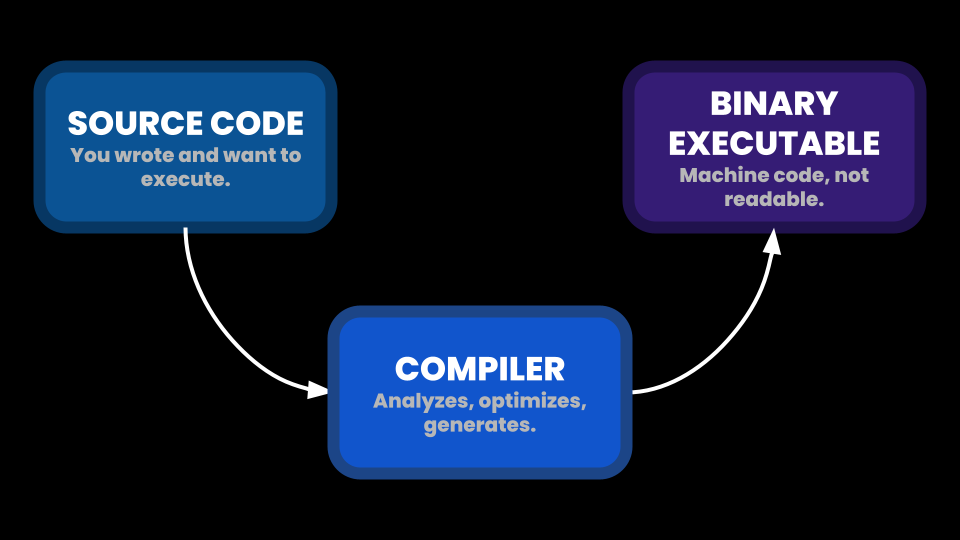
This is a flowchart detailing how source code passes through a compiler prior to execution, resulting in a binary executable.
How Does a Compiler Work?
Lexical Analysis: The source code is broken into tokens (e.g., keywords, identifiers, symbols).
Parsing: Tokens are organized into a syntax tree that reflects the grammar of the language.
Semantic analysis: The tree is checked for meaning. Are variable types correct? Do functions exist?
Optimization: The compiler rewrites parts of the code to run faster or use less memory.
Code Generation: The final machine code or bytecode is written to a file.
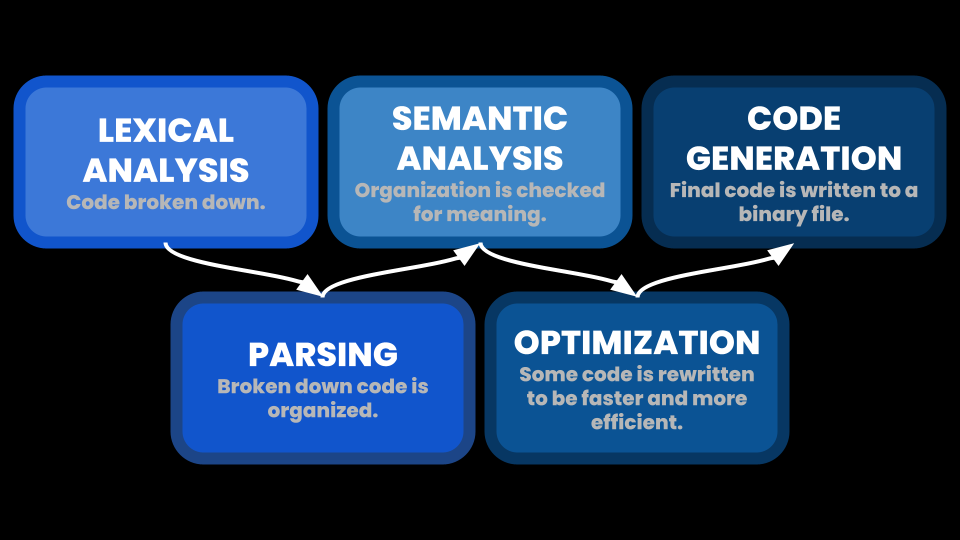
A flowchart depicting the general five step process to compilation: lexical analysis, parsing, semantic analysis, optimization, and code generation.
Common Compiled Languages
Languages like C, C++, Rust, and Go use compilers.
Advantages and Disadvantages
Advantages of a Compiler
Faster Execution: Code is pre-translated and heavily optimized for the specific CPU.
IP Protection: Source code is securely converted into binary format.
Error Detection: Compilers check the entire program for syntax and type errors before it runs.
Disadvantages of a Compiler
Slow Setup: Larger programs take time to compile.
Platform Dependent: Compiled executables are tied to specific hardware and operating systems.
Strict Error Handling: If the code contains a single syntax error, the compilation fails.
What is an Interpreter?
It's a program that reads, translates, and executes your source code line-by-line (or statement-by-statement) dynamically while the program is running.
It does not produce a standalone binary; instead, it acts as the bridge between your code and the computer's processor in real-time.
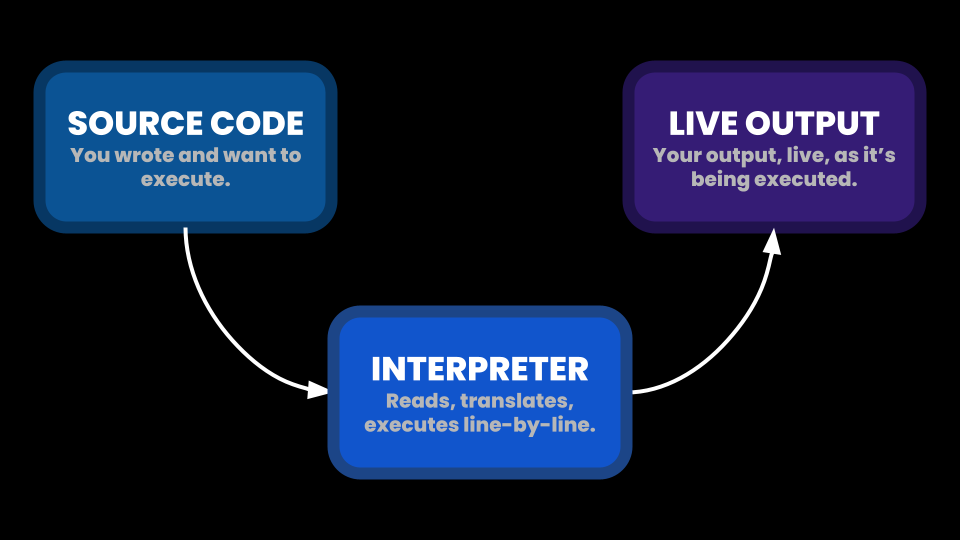
A diagram showing how source code flows past an interpreter in real time, generating live output as the code is being executed line-by-line.
How Does an Interpreter Work?
Read: The interpreter fetches a single line or statement of source code.
Translate: It converts that specific statement directly into an intermediate representation or machine operations.
Execute: The computer executes the translated instruction immediately.
Repeat: The interpreter moves to the next line in the script.
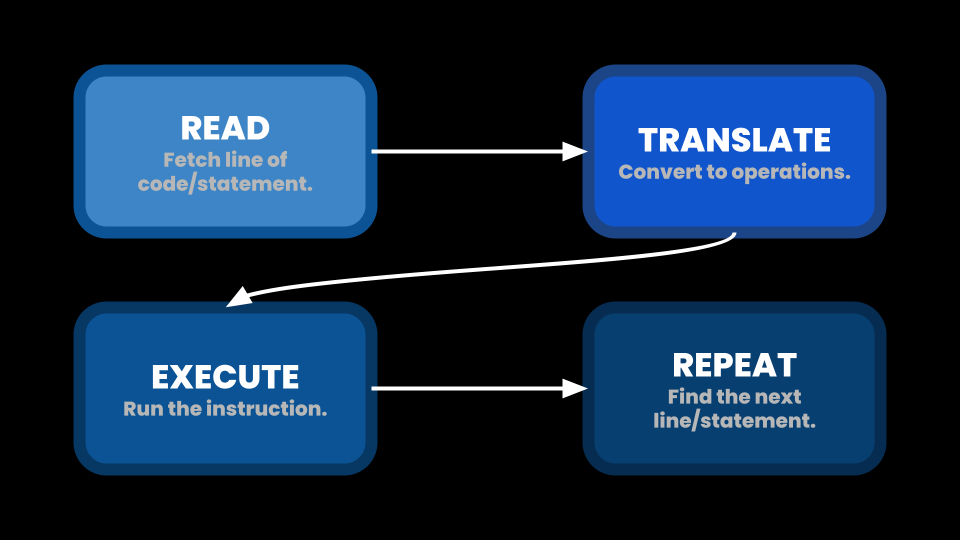
A diagram describing the process of interpretation: reading of the code, translating to operations, execution of instructions, and repetition.
Common Interpreted Languages
Languages like Python, JavaScript, Ruby, and PHP use interpreters. Because translation happens at runtime, you can run the code instantly without waiting for a build step.
Advantages and Disadvantages
Advantages of an Interpreter
Instant Feedback: Code runs without compilation phase.
Cross-Platform: Same source code can run on any machine, provided that it has interpreter installed.
Dynamic Typing: Can change data types and object structures on the fly.
Disadvantages of an Interpreter
Slower Execution: Program runs slower because translation overhead.
Runtime Errors: Syntax and type errors are only caught when the interpreter reaches the problematic line.
Source Code Exposure: Raw source code must be distributed to run the program.
Which One To Use
When to Use a Compiler
Choose a compiler if you need...
maximum hardware performance.
raw speed.
secure code distribution (e.g., video games, operating systems, or heavy infrastructure).
When to Use an Interpreter
Choose an interpreter if you value...
quick prototyping.
interactive debugging.
the ability to run your code across multiple operating systems without rebuilding it (e.g., web development, scripting, or data science).