What is AI?
What It Is
Artificial Intelligence (AI) is a branch of computer science focused on making systems that are capable of performing tasks that typically require human intelligence.
These tasks include understanding language, recognizing patterns, making decisions, and solving problems.
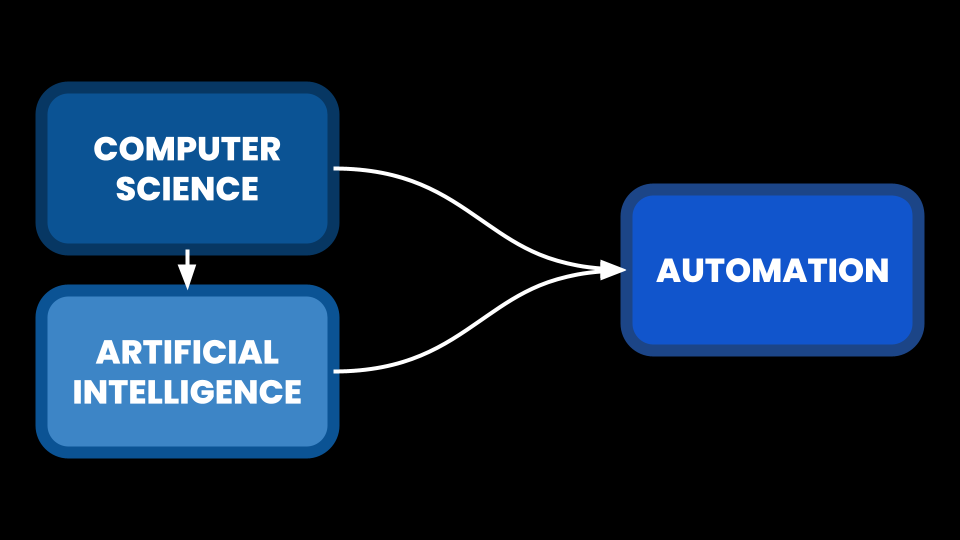
A diagram showing how AI is a branch of computer science. The flowchart shows that not only is AI a subset of computer science that aids in automation, but computer science as a field as a whole aids automation in many ways.
The Term “AI”
The term AI was coined in 1956 by computer scientist John McCarthy. He defined it as, “the science and engineering of making intelligent machines.”
Today, it refers to any computational system made to simulate cognitive functions, such as reasoning, learning, perception, and problem-solving.
How Does AI Work
Machine Learning (ML): ML systems learn patterns from large datasets.
Deep Learning: A subset of machine learning that uses layered neural networks. Structures are loosely inspired by the human brain.
Natural Language Processing (NLP): Enables machines to read, understand, and generate human language.
Computer Vision: Allows machines to interpret visual information from images and video.
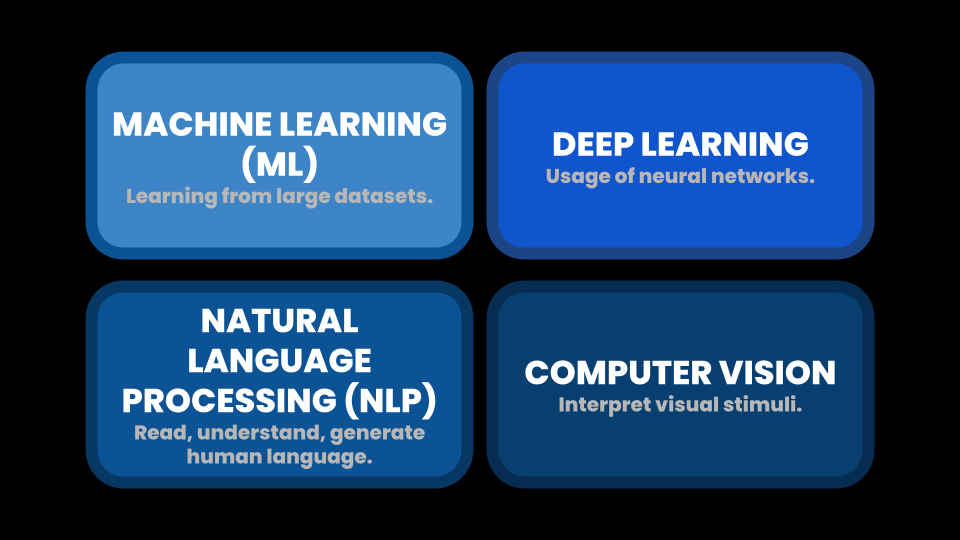
This image describes the four cornerstones of AI functionality: machine learning, natural language processing, deep learning, and computer vision.
Categories of AI
Narrow AI: Designed for a specific task (e.g., chess, image classification). Exists today.
General AI (AGI): Capable of performing any intellectual task a human can. Does not yet exist.
Superintelligence: Hypothetical AI surpassing human intelligence across all domains. Theoretical.
Common Applications of AI
Healthcare: disease diagnosis, drug discovery, medical image analysis
Finance: fraud detection, algorithmic trading, credit scoring
Transportation: route optimization, autonomous vehicle navigation
Manufacturing: predictive maintenance, quality control
Communication: language translation, spam filtering, voice assistants
Education: adaptive learning platforms, automated grading
What are the Limits of AI?
Require large amounts of high-quality training data
Can reflect biases present in that data
Lack genuine understanding: they recognize patterns, not meaning
Perform poorly when encountering situations outside their training distribution
Decisions made by complex models are often difficult to interpret or explain
Summary
AI is a set of technology that enable computers to perform tasks commonly requiring human intelligence. It is a broad field that includes machine learning, neural networks, natural language processing, and more. Today’s AI is powerful within specific domains but remains far from the general-purpose intelligence seen in humans. Its applications are widespread, and its development continues to accelerate across research and industry.